Technology is moving the classroom more and more toward digital learning. However, there are times when digital learning may be more convenient but is not necessarily better for students. Sometime dirty hands are better than a clean keyboard.
Let me give you an example. I teach forensic science to high school juniors and seniors. Our curriculum calls for the examination of blood spatter pattern analysis. This can technically be done with digital photos, but who wants to look at a high-resolution photo when they can sling a little imitation blood around and see what happens.
I envisioned a room of PVC and clear plastic where students could enter the room, perform a task, then analyze the blood spatter. I applied for grants and was awarded 2 separate grants that not only allowed me to buy the materials for one such room, but I also had enough funds to buy the materials to build 4 rooms. These rooms were intended to be 10’ by 10’. I had a plan, I had child labor in the form of eager students who were excited to help construct our blood rooms, and we set out to get started. And then I ran into a slight problem in the form of wind, more like a breeze, the faint breeze of a baby’s breath. That was all it took to make our PVC buildings come crumbling down. On the rare occasion that we managed to attach a wall of plastic to our PVC frames, our buildings under construction turned into sails and occasionally send us all a few feet further than our starting point.
It was an epic failure full of laughs and groans, but a good time was had by all, surprisingly. That night I went back to the drawing board. Outside in the wild winds of southern Georgia, where a 9 mph breeze destroyed student built blood rooms, was just no longer an option. And 10’ buildings would not work inside where the ceilings were 10’ as well. I could not use a 10’ building but maybe I could use a 5’ by 5’ cube, closed on 5 sides, where students could still perform a task and then analyze the splatter.
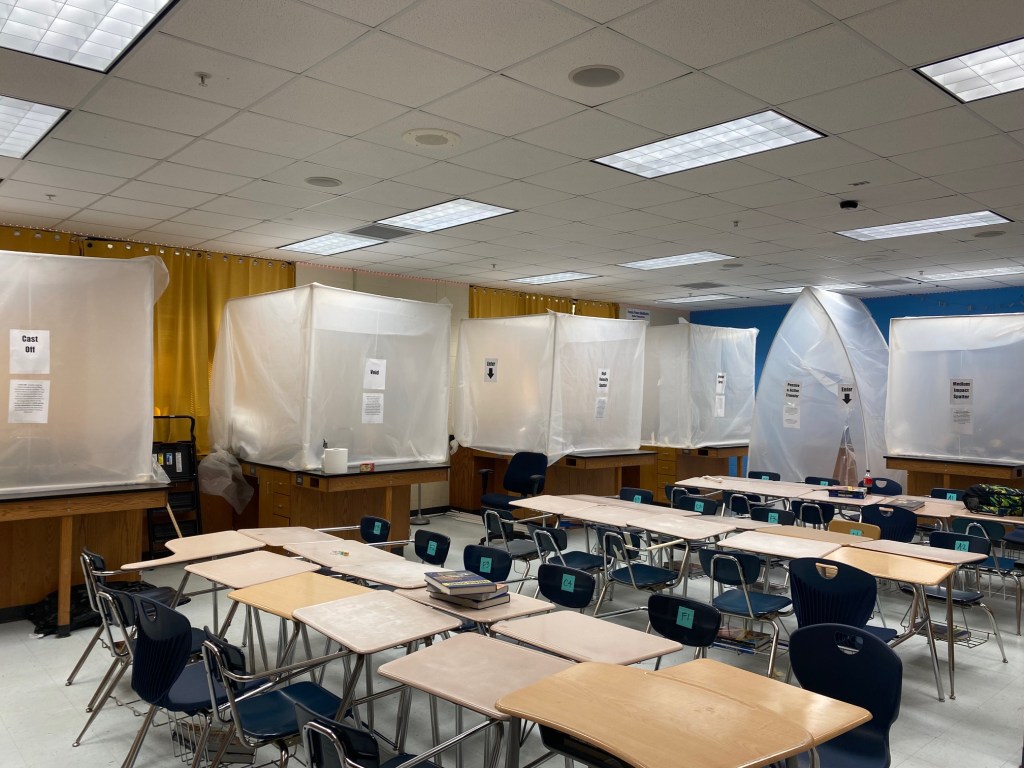
The next day, instead of trying to rebuild our windblown blood rooms, we built lab toppers made of PVC and plastic sheeting. Each smaller room had a purpose: cast-off, arterial spray, high velocity spatter (gunshot), medium velocity (blunt force), passive transfer, smears, and voids. Cast-off was made possible by a ruler dipped in a cylindrical container. Arterial spray used a spray bottle set to stream. High velocity spray also used a spray bottle set to mist. Passive transfer required the students to dip their palm in a bowl of the blood analog and watch gravity impact the shape of the drips. They were to then wipe their hand on the internal wall of the mini room to demonstrate a blood smear. Medium velocity spatter and the void were both created by attaching a sponge soaked in our blood analog, attached to a bicycle helmet, and struck with a baseball bat. I was prepared for the mess. I was not prepared for the giggling between hits from the bat to the helmet. Each student waited their turn with suspicious eyes as the students ahead of them entered the small lab room one-by-one and began to giggle. And as they each took their turn, they dissolved into giggles, too. It was amusing, a bit disturbing, but overall satisfying as a teacher.
The following day we discussed what they learned from the activity. Students were able to articulate their observations very well. And they were still talking about it a week later. Steve Spangler is a science teacher turned teacher of science teachers. He specializes in teaching teachers how to make science fun. An often guest on The Ellen Show, he once stated, “I always tell teachers, if it gets to the dinner table, you win” (Sick Science!, 2008). When teachers from all over my school have told me the kids were talking about the lab days later, I know we all have won. But the best indicator of success is when former students come back and say, “You did not do that with us!”
What my students learned:
- Getting dirty can be a fun learning experience.
- Plans fail and sometimes they need to be re-imagined.
- Teamwork can be rewarding when everyone works for the same goal.
- Sometimes a group of boys needs one girl to take charge and tell them what to do. (This was not my assessment, just my observation. They were floundering until she stepped in, took charge, and lead them to success.)
- Blood spatter patterns really do tell the story of what happened.
- Learning can be fun even after elementary school.
What I learned:
- Even the best made plans fail sometimes, and that is ok. As a teacher, we cannot be expected to be perfect all the time. Instead, we can model how to adapt and overcome because, in life, we will have times when plans fail, and we must figure out another way to complete the goal.
- There will always be a few students who do not respond to a lesson, no matter how well that lesson is planned for every student. Find another way to reach the few that need something different.
- Building is fun, experimenting is even more fun, clean up is not fun at all!
- Put plastic down for a floor next time. It will make clean up a lot easier.
- No matter how many times you remind them not to eat the blood analog, when they smell chocolate, someone will lick their fingers.
- The blood analog looks, feels, and acts a lot like blood. However, if allowed to sit overnight, it hardens like peanut brittle, adhering itself to the surface it lands on with an adhesive strength stronger than gel based permanent glue.
Supplies for the 10’ x 10’ rooms:
- ½” x 10’ PVC poles
- 12’ x 100’ clear plastic sheeting (4 mil)
- ½” 3-way elbows
- ½” 90-degree elbows (not used in the scaled down version)
- ½” 90-degree tee (not used in the scaled down version)
Supplies for the blood analog:
- Corn syrup
- Cocoa powder
- Red food coloring
- Water, for consistency (This is extremely important in the spray bottles)
Sick Science! (2008, March 4). Steve Spangler on The Ellen Show September 2007. YouTube. Retrieved March 10, 2023, from https://youtu.be/2qlb8X_ffO8




 Education, etc.
Leave a comment